
Compact cameras are generally fairly powerful tools these days. Like all tools, getting the best out of them requires you to know how to use them. I’m not talking about deep photographic expertise here, but just a little knowledge that will go a long way to improving your pictures.
I had a great conversation with a couple of my dearest friends this summer when they were getting some pictures on their Fuji compact on an alpine holiday that were too bright or dark or perhaps in poor focus. Over a beer in an alpine hut I showed them the two simple things that they needed to do to get better pictures. (I tried not to bore them too much). They tell me that they have made extensive use of these two simple things since then and that they have been enjoying their photography all the more since; they feel more in control of their compact, they are getting fewer disappointing pictures, and they have avoided learning anything more about cameras than they need to know.
In this entry, I want to discuss the first and most important technique for taking control of your compact:
Controlling the focus.
.jpg "dscf0026")
In the picture above, I’m not sharp but the background is. The camera has guessed that the centre of the scene is the priority and focussed on the boats and mountains.
.jpg "dscf0027")
Here is a picture a moment later to show me sharp for comparison, as my wife intended.
Have you ever photographed someone you really wanted a picture of, and found that they weren’t as sharp as the tree behind them, or a different person in the scene? This is the most common problem with a compact camera on “auto” mode. It tries to intelligently guess what part of the scene you would like to be pin sharp, and sets the focus on that point. Unfortunately, even the most expensive compact camera isn’t as intelligent as you are, and simply can’t always guess what your subject is. As long as you let the camera decide for you then some of your pictures will disappoint you by having your subject out of focus.
So what do you do about it? These days there are three focus modes built into most compacts:
1. Auto or intelligent focus: This is the one that causes the problems, it decides, and it does get it wrong a lot. If you really don’t care about nailing the person or item you might not get to photograph again, then leave it in this mode and take your chances.
.jpg "p1000416")
2. Manual or centre Focus: In a compact this means that the “auto or intelligent” focus is switched off. This will almost always give you a simple focus point in the centre of your screen. When you press the shutter button half way, the camera will focus on that centre point while you hold the shutter half way down.
.jpg "p1000414")
3. Face detection: This is the latest and very useful thing, but it shouldn’t be left on all the time unless you only ever take party or people pictures. It automatically detects faces in the scene and tries to ensure that they are all in focus. That may sound great, but there are times when you only want your husband’s face in focus, and the other people at the party, more out of focus. You can do that so much better without “face recognition”.
.jpg "p10004151")
So my simple rule for you is this:
To control your focus and get the subject sharp EVERY TIME without your camera messing up for you, choose the second option: manual focus or “intelligent” or “face recognition” off. The technique now is simple. Place the subject at the centre of the scene, half press the shutter button until the camera indicates that it has locked focus, now KEEP HOLDING THE BUTTON HALFWAY DOWN while you move the camera a little to compose the scene the way you want it. (You might not want the subject in the centre.) When you are ready, assuming the subject has stayed still, press the whole way and take the picture. This is called “focus and recompose”.
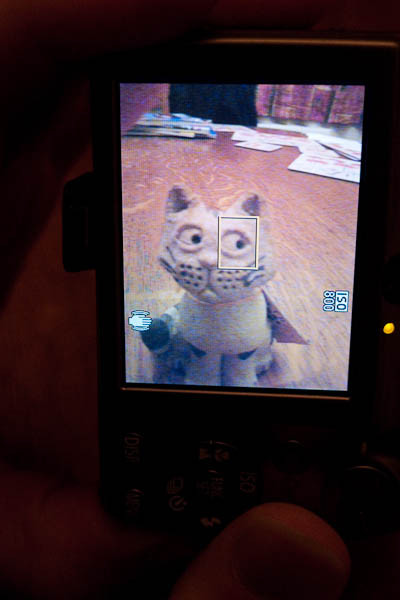
In the above picture, I have focussed over the moggie’s eye, I am holding the shutter half-pressed, and I can slightly move the camera until the cat is where I want it in the frame.
If you focus and recompose, you will always choose what is in focus, and as long as you keep your finger halfway pressing the button, your chosen subject will stay in focus. Practice this with your compact and you will get the right part if the picture sharp every time.
Note: Every camera has a different menu, and may use different wording for the focus settings. If you can’t figure them yourself, ask a photographer friend to look for you, or take it into your local camera shop and ask for their help with it.
Next lesson: We’ll look at the second simple technique, controlling exposure.

.jpg "p1000404")
.jpg "p1000408")
.jpg "p1000410")

.jpg "splash")

